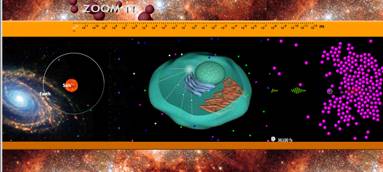
Powers of Ten and Molecular Models
In this activity students go down
the scale and are introduced to atoms and molecules, and the basics of states
of matter. This may serve as their first acquaintance with the molecular
underpinnings of chemistry.
Equipped with this information, they are better able to understand their
next investigation, the water cycle's evaporation and
condensation, both important aspects of defining an ecosystem.
Activity: Up and Down the Scales (teacher)
Overview
Understanding scale is a
fundamental science skill. Students will use Molecular Workbench software to get a visual sense of the relationship
between objects of that size and a particular power of ten. In this day's activity, students undertake a Powers of Ten
trip through the universe down to the level of molecules, in particular, the
water molecule.
Goals and Objectives
The goal of the activity is that students will develop an intuitive
understanding of the placement of objects such as the Solar System, their
school and study site, a human being, cells and atoms on a relative scale.
Students will be able to place on a relative scale a set of objects drawn from
different places along a powers of ten scale.
(While young students need not
fully grasp the exponential nature of distances involved, older students may be
able to actually derive and graph an exponential from a lab experience. See
Deriving the Exponential.)
Preparation
Have Molecular Workbench opened
to the Powers
of Ten activity on the class computer(s).
If double-clicking does not work,
copy and paste this address into your browser:
http://mw2.concord.org/tmp.jnlp?address=http://mw2.concord.org/public/part2/ZoomIt/main.cml
Materials
Microscopes
5-6 meter sticks
Steps:
1. Working with microscopes:
Look at a leaf under a microscope, if one is available. Have students record on the Powers of
Ten student chart what they can see with the naked eye, then at 10x, 100x and
any other available magnifications.
2. Working with meters: A
meter is a unit that is within grasp, as is a fraction of a meter and roughly 5
times a meter. We will need to
extend that understanding to give them a chance with the kind of scale relevant
to atoms and molecules.
Ask students to select an object
in the classroom that is one meter in length. They should use it, or meter long sticks to measure other
objects in the room.
3. Have students then use
a.) the Molecular
Workbench software
If double-clicking does not work,
copy and paste this address into your browser:
http://mw2.concord.org/tmp.jnlp?address=http://mw2.concord.org/public/part2/ZoomIt/main.cml
and, if there is time, b.) the
Eames web site to explore up and down through various magnifications.
http://micro.magnet.fsu.edu/primer/java/scienceopticsu/powersof10/
Students should locate objects
that they place on the following table:
|
Meter scale |
Exponential |
Examples |
|
Nm |
-9 (one billionth) |
|
|
Microns
(micrometer) |
-6 |
|
|
Mm |
-3 |
|
|
Cm (centimeter) |
-2 |
|
|
M (meter) |
-1 |
|
|
KM |
+1 |
|
They should then asked to think of additional
objects that should go in that "layer."
5. Assemble students in
teams. Do the game in which
various images from the Eames site need to be arranged in order.
http://www.powersof10.com/index.php?mod=nickelodeon
Other resources include:
http://micro.magnet.fsu.edu/optics/activities/teachers/perspectives.html
6. Powers of Ten GL Collection
Collect pictures of objects and
submit them to their appropriate Power of Ten on the Global Lab Web Site. Please try to avoid submitting
copyrighted images. Sources of free images include government agencies, e.g.
NASA, and Wikipedia).
[ADD LINK
FOR PICTURE SUBMISSION]
Title:
Browse for picture
Current Levels Available for
Submission
(10) 12, 8, 7,6,5,4,3,2,1,0,-1,-2,-3,-4,-5,-6,-7,-8,-9,-10,-12
Description:
Test:
Match the object with the unit in
which it is measured.
|
a skin cell |
(mm) |
|
a planet |
(microns) |
|
a virus |
(thousands of kilometers) |
|
a grain or small crystal of salt |
(km) |
|
city park |
(cm) |
Student
Journal Reference: Metric Prefixes
|
|
Multiplier |
|
|||
|
Prefix |
Numerical |
Exponential |
|||
|
yotta |
1,000,000,000,000,000,000,000,000 |
1024 |
|||
|
zetta |
1,000,000,000,000,000,000,000 |
1021 |
|||
|
exa |
1,000,000,000,000,000,000 |
1018 |
|||
|
peta |
1,000,000,000,000,000 |
1015 |
|||
|
tera |
1,000,000,000,000 |
1012 |
|||
|
giga |
1,000,000,000 |
109 |
|||
|
mega |
1,000,000 |
106 |
|||
|
kilometer |
1,000
|
103
|
|||
|
hecto
|
100 |
102
|
|||
|
deca |
10 |
101
|
|||
|
no
prefix means: |
1 |
100
|
|||
|
Decimeter |
0.1 |
10¯1
|
|||
|
Centimeter |
0.01 |
10¯2
|
|||
|
Millimeter |
0.001
|
10¯3
|
|||
|
Micro meter |
0.000001
|
10¯6
|
|||
|
Nanometer |
0.000000001
|
10¯9
|
|||
|
picometer |
0.000000000001 |
10¯12 |
|||
|
femtometer |
0.000000000000001 |
10¯15 |
|||
|
attometer |
0.000000000000000001 |
10¯18 |
|||
|
zeptometer |
0.000000000000000000001 |
10¯21 |
|||
|
yocto |
0.000000000000000000000001 |
10¯24 |
|||