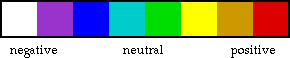
- Dipole-dipole attraction
- Some molecules form areas of positive and negative charge
formed through an uneven sharing of electrons (polar covalent bonding).
Water is formed with polar covalent bonds between hydrogen and oxygen.
Below is water.
Spin the molecule.
Create molecular surface.
Show electrostatic potential.
Make surface transparent.
Make surface opaque.

- Because part of the molecule is partially positive (not as positive as an ion with a +1 charge) there are attractions between the negative portion of one molecule and the positive portion of another molecule. This attraction forms weak bonds between molecules
- When hydrogen is one of the atoms within a molecule that is attracted
to the dipole on another molecule, this somewhat stronger dipole-dipole
attraction is called a hydrogen bond. The hydrogen bond is the
attraction between molecules, not the covalent bond which is formed
between hydrogen and an atom from its own molecule. Below are
some examples of hydrogen bonding.
- The dotted line below show the attraction/hydrogen bond between
two water molecules.
(This video clip, used with permission, was developed at the NYU Scientific Visualization Center.) - To see a 3D view of water and it's hydrogen bonds in motion
go to: http://polymer.bu.edu/vmdl/Installers/water/install.htm
and follow the instructions for installing the software. (Windows
only.)
- Hydrogen bonding is also an important factor in helping to shape the structure of larger molecules. DNA is an excellent example. Click here to see how these bonds hold together our double helix.
- The dotted line below show the attraction/hydrogen bond between
two water molecules.
- A molecule can have more than one polar region, so the more polar regions a molecule has, the greater two molecules of this kind will attract to each other.
- Some molecules form areas of positive and negative charge
formed through an uneven sharing of electrons (polar covalent bonding).
Water is formed with polar covalent bonds between hydrogen and oxygen.
Below is water.
- London Dispersion forces
- Even when atoms are sharing electrons equally, the electrons are not static objects. They are constantly in motion. Sometimes due to their random movement between the two atoms in covalent bond they just happen to be more on one side than another.
- A fleeting instantaneous dipole (region of positive and negative charge) can be formed by the random distribution of electrons at any particular moment.
- This instantaneous dipole can induce a dipole in another nearby non-polar molecule. They can then attract to each other in a similar way as the dipole-dipole attraction. However, the London dispersion force is much weaker than a dipole-dipole attraction.
- The size of a molecule can affect the London dispersion force between two molecules. The more surface area there is on a molecule the greater chance there will be at least one instantaneous dipole at any particular moment. Therefore, the greater the surface area (generally this means the bigger the molecule) the stronger the attraction between two molecules of this type due to London dispersion forces.
- The visualization below, used with permission, came from the Colby College chemistry department and was created by Thomas Poon and Bradford Mundy.